Showing posts with label Vertical Shmup. Show all posts

Wednesday, June 22, 2022

Phelios (Genesis) Review


Phelios (Genesis) Review


Release Date: 1990

Date Played: 22 June 2022


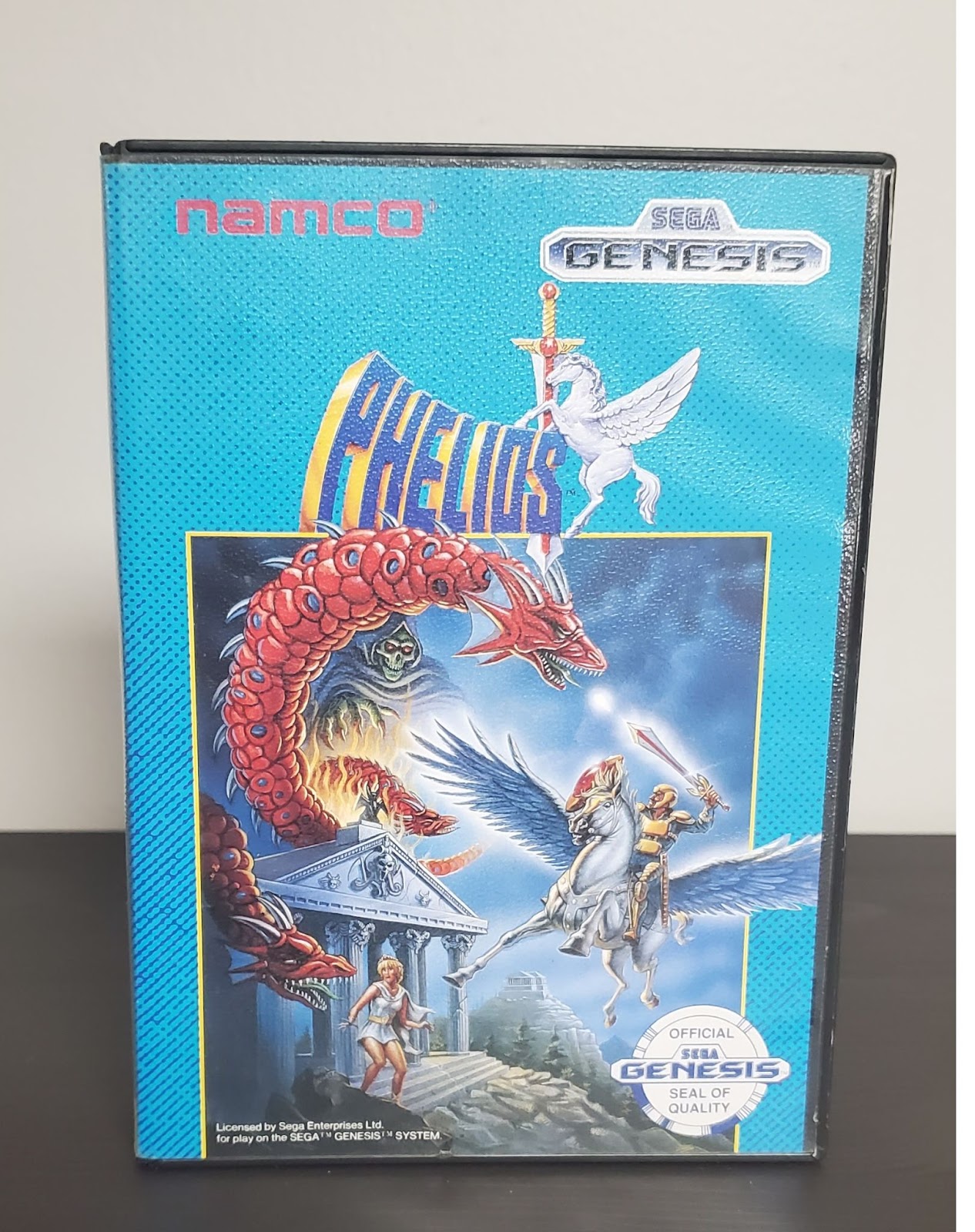
Phelios is one of the more unique vertical shmups on the Sega Genesis.  Instead of opting for the standard spaceship theme, Phelios opts for an Ancient Greek setting that is a breath of fresh air for a genre that can often get rather stagnant. Published by the venerable Namco, Phelios was originally an arcade game before being ported to Sega’s 16-bit system where it gained more popularity.
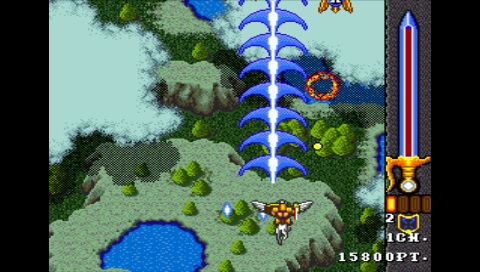


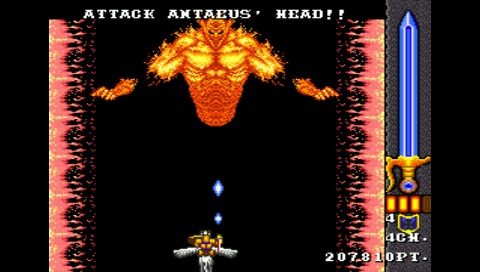
Ultra hottie, Artemis, has been kidnapped and imprisoned by the Titan, Typhon.  Telepathically, I assume, Artemis calls out to her boyfriend, Apollo, to come and rescue her.  Apollo, the sun god, notorious womanizer, and actual brother of Artemis (the game doesn’t mention this… gross) sets off through 7 stages of vertical shmup fun to save his lover/sister.  Mounted on the back of Pegasus, you’ll be killing countless enemies, recognizable bosses from Greek mythology, and flying over vast terrain that ranges from the clouds over Mt. Olympus, to underground caverns, lava filled lakes, sky fortresses, rivers, and the underworld.


Gameplay:


The gameplay is as simple as it comes.  Phelios is essentially a one button game.  You can move with the D-pad, and shoot with any of the other buttons on the controller.  The button can be held down to charge your attack for additional damage.  To the right of the screen is a picture of a sword, and the longer you hold the fire button, the more it’s filled.  When it reaches its maximum after about 2 seconds, you can fire a super charge shot that deals additional damage.  Don’t worry about having to take your eyes off the screen to see if the gauge is full, the constantly beeping alarm will annoyingly notify you when it’s maxed out. Of course, tapping the fire button will fire smaller and weaker shots, but you’ll barely be using them in the game. The charge shot is so much more useful and powerful that it becomes your main mode of attack. It’s obvious that the game was designed around using the charge shot all of the time as it has the ability to pass through destroyed enemies, so a single charge shot can take out an entire enemy wave.  Sadly, this more or less turns the game into a timing challenge where you have to learn to rout the game based on when to release your charge shot rather than dodging enemies and their bullets.  The gameplay centers around knowing which enemies are coming and blasting them with the charge shot as soon as they’re on screen so they don’t have a chance to fire at you. This makes Phelios more of a memorizer shmup rather than a reflex one.


In addition to this, you’ll get several powerups in each level that will increase your speed up to 2 levels and can also provide you with a couple of options to increase your firepower.  Having Apollo fully powered up is somewhat helpful, but not as much as many other shmups. The game throws so many upgrades at you that you’ll be fully powered up 30 seconds into the first stage. Also, whenever you die, you’ll get several upgrades just as soon as you respawn at the checkpoint, thereby ensuring you are mostly powered up at all times.  On top of this, there are several additional weapons you can get temporarily in some of the stages.  These include a beam shot (only found in the first level), homing shots, and a ricochet shot.  These special upgrades are a lot of fun and are very powerful.  Unfortunately, they only appear rarely and feel like more of an afterthought than a real feature.  


You can take 3 hits before you lose a life and you only have 3 lives to start with.  Luckily, you get a 1UP every 50k points (maxed at 400k), so you can get up to 8 additional lives to help you on your way. You’ll need them too, because while the game isn’t extremely difficult, it has some cheap and unfair sections that love to eat away at all your extra lives.  There is a checkpoint system in place that makes the game much more difficult.  Usually these are to give you a chance to power up your ship so you can make it through a more difficult section, but in Phelios you fully upgrade so quickly that there’s really no need for a checkpoint system (as being fully upgraded isn’t that much stronger than your base shot). It just makes the more difficult sections frustrating when you have to play them over and over again. I think the game would have been much better if it gave you fewer lives but allowed you to respawn right where you die. To make matters more difficult, your character sprite is rather large and it can be hard to dodge some of the enemies on screen. So, you’ll be dying a lot at first and will have ample time to get used to the checkpoint system. The game is also too long, clocking in at around 45 minutes and has no level select. Which means you’ll need to spend a fair amount of time playing through the early stages just to get in some practice for the latter ones. This can be a real motivation killer and you’ll have to push yourself through some tougher sections through sheer force of will.


There is a novice mode of the game that’s easier, but only lets you play the first 4 stages of the game. You’ll have to dive into the Advanced mode if you want to experience the full game.  If you’re able to beat the final boss, you can take a shot at Expert mode.  Weirdly enough, if you want to play this mode, you’ll need to beat the entire game on Advanced mode each time you turn on your Genesis because there is no battery backup in the cartridge.


Presentation:


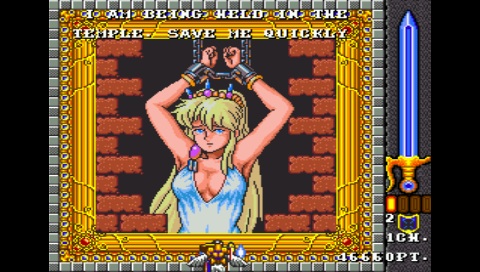
Phelios’ presentation is the best thing it has going for it. The Greek mythology theme really does stand out and gives the developers some awesome content to work with.  The first stage blasts right out of the gate as you see Apollo and Pegasus flying over some impressive parallax scrolling clouds as you blast away at dragons and… butterflies.  You’ll soon dive into a temple where you’ll face off against a horrible looking Medusa.  After vanquishing her, you’ll get a cutscene of the scantily clad Artemis asking you to save her in the most “Genesis” sounding voice sample. These cutscenes appear between every stage and show how Artemis is being tortured and progressively more and more…. um, derobed.  This was undoubtedly the motivation to get a lot of male gamers in the 90s to keep playing the game. I have no doubt that it worked.  Artemis might be the best looking 16-bit character ever committed to cartridge and is the standout thing that most people remember about Phelios.  


Sadly, after the first epic level of the game, things start going downhill.  The stages start getting long and repetitive with boring terrain and annoying enemies. It feels like a lot of them drag on forever.  This is very clear during the lava, ice, and lake stages.  They feel like they will never end and just keep throwing the same sorts of enemies and ideas at you over and over. On a positive note, the final stage mixes things up and somewhat redeems the tedium of the rest of the game. It just feels like less care and thought went into the middle section of the game. With the boring backgrounds, difficulty spikes, repeated assets, and general laziness in the presentation, you can tell that the developers didn’t really have the resources they needed to pour their hearts into them like they did the first level.


The graphics are decent enough for a Genesis game and have that gritty and stony look to them that you would expect. The first level feels colorful, fast, and really shows off what the Genesis can do.  This isn’t really the case for the other levels, sadly.  The soundtrack is mostly ominous trumpet fanfares.  It works well for the game and does give a sense of regality and epicness.  However, the tunes are rather pedestrian and there isn’t anything catchy for you to want to repeatedly listen to.  It’s a long way from the best shmup soundtrack on the Genesis. 


Conclusion:


Phelios is a slightly better than average game overall.  It has some highlights that help it out, but also has plenty of low points that keep it from being truly great. Honestly, the best thing it has going for it is its Ancient Greek setting.  Without that (and the Artemis cutscenes), this game would be relegated to the tons of other middle-of-the-road shmups on the Genesis. It has its moments, for sure,  but the heavy reliance on using the charge shot all of the time weighs thin.  The same can be said for the overly long and repetitive levels that fill up most of the middle sections of the game. On top of that, some of the cheaper and frustrating sections of the game are made that much more irritating by the unnecessary checkpoint system.  


If you’re a huge shmup fan and a collector, you’re probably going to have to shell out some real cash to pick up a physical copy of this game as its value just keeps going up and up.  For the rest of you out there, try it digitally.  It’s a good and memorable time if you can get it for a reasonable price.


Pros:

  • Unique setting and atmosphere

  • Moderate difficulty for a shmup.  Actually beatable by the general public.

  • Great first level

  • …Artemis


Cons:

  • Too much reliance on the charge shot

  • Stages can be boring, long, and repetitive

  • Can’t play the full game on Novice mode

  • Music is lackluster

  • Unnecessary checkpoint system turns the game into a drag

  • Some cheap sections of the game can be frustrating


Final Status: Beaten

Final Score: 7/10 (Good)


Wednesday, February 16, 2022

Raiden III (PS2) Review

Raiden III (PS2) Review

Date Released: 17 April 2007

Date Played: 16 February 2022

Introduction:

Raiden III is actually the fourth game game in the legendary, but highly overrated, Raiden Series.  Developed by MOSS, a company formed from the remnants of Seibu Kaihatsu (the creator of the original Raiden) this was the first game from the series to make it to the Playstation 2 where it was published by modern shovelware peddlers, UFO Interactive Games. It is almost a direct port of the arcade version of the game but does have some additional content to fill out the package. While sporting higher quality graphics, it isn't much of a departure from the earlier entries in the series and fails to innovate or change the gameplay in any meaningful way.  It was met with mediocre reviews from both the critics and the fans alike, and while it may have a few people out there who praise it, it's generally seen as nothing special by today's standards.


Gameplay:

Raiden III is a vertical shmup just like all of the other games in the series.  This time around you can only play as one ship (the red one) through the games 7 stages.  Luckily, there are 7 different difficulties this time around ranging from Practice all the way to Very difficult (much harder than the arcade version of the game).  As is standard with the series, your ship is very slow and chunky and the enemy bullet patterns are lightning fast.  If you've ever played one of these games before, you'll know that it's not the sort of game where you're supposed to react to the enemies and bullets, but rather memorize where they're going to be so your ship can be somewhere else.  In a bit of a departure the game has incorporated some danmaku elements to give the game a bit of a bullet hell feel with large swarths of bullets that you have to weave your way through.  Unfortunately, it tries to live as both a simple throwback to the original Raiden while adding the thicker waves of bullets and it leaves the game as feeling as though it's serving two masters but failing at both.  It never really gains a sound footing in the aspect and it's very obvious.  Your ship just doesn't have the manuverabilty that's required to make quick tap dodges like the game wants you to do.  This might be slightly easier with an arcade stick, but on the standard PS2 controller, you're going to be having fits.

Also missing is the Raiden series' ability to scroll the screen a little to the left and right as you're playing.  I know this is a much maligned feature because of the enemies that can hide right off screen and wait for you to scroll over towards them only for them to pop out of nowhere and blast you from behind with a bullet, thus ruining your run.  That means that this time you're confined to just the narrow vertical portion of the screen that you can see all of the time.  Not having any enemies hiding off the left or right of the screen is a blessing, but the space to which you're afforded feels very confined and claustrophobic.  Many of the enemy patterns push you to one side of the screen and make you feel like you don't really have the room you need to maneuver.  This also makes the game feel less like a Raiden game overall.  

You have 3 shot types that can be powered up or switched between by grabbing one of the 3 colored orbs that hover from fallen enemies around the screen.  The first is the red orb that's your spread shot, the blue orb which is a focused and powerful laser, and sadly the teal orb which is another laser that is hard to direct and control but is more powerful than the blue laser.  Missing is the the classic purple orb that gives the lock-on laser that is probably the most well known element of the entire franchise.  It's a total shame that it's not here and I feel like the remaining weapons are too boring and lack any sort of punch to make you feel like you have any real power in the game. Each orb will slowly cycle through the three colors as it floats around the screen, and if you pick up multiples of the same colored orb, your shot will become more powerful and pack a bigger punch. You also have 3 sub-weapons that continually fire with your normal shot while you hold down the button.  There are the missiles that are most powerful and fire straight ahead, the homing missiles that are weak but good about picking up straggler enemies you may have missed, and the new option, radar missiles, which are a combination of the two previous types and are a little stronger and home a little bit, but not completely.  Sadly, when any of these powerup orbs drop, they can be quite the challenge to collect because of the absurdly slow speed of your ship.  They also tend to hover towards the top part of the screen, enticing you to venture upwards to grab them and meet your certain doom.  To make matters worse, the orbs will also be stuck hovering on the screen where you don't want to collect them because you may not want to change your shot type, so you spend a lot of time avoiding the orbs until they cycle into the color that won't screw you over before you have to quickly collect them.  It's very frustrating and avoiding the powerups is sometimes as important as collecting them.  I rarely like this in any shmup, but it's far more grevious in Raiden because of the labor intense process of chasing down the orbs with your sluggish ship.  Finally, you're given a standard screen clearing, and life saving, bomb.  An extra one of these is usually dropped in each stage and knowing when to use them to save your hide from a lightning quick series of bullets from a boss is something you'll be dealing with constantly.

As you play through the games 7 levels, you'll encounter a dull and washed out city, and bland and brown ravine, a shipping port, an actually cool looking outer space level with a nice nebula in the background, and grey enemy fortress, another outer space level, and an enemy planet that's mainly just a field of brown grass.  It is all standard Raiden stuff, but feels especially bland in it's color choices and looks like a brown and grey mess most of the time. 

There are also score multipliers for chaining together kills in rapid succession, but they only go up to a 2X multiplier.  You can also collect various fairies and golden orbs for bonuses if you're playing for score.  In addition to this, you have the ability to do a score attack, boss rush, start from any level for practice, and even tackle the one and only new idea in the game.  This new idea is called Double Play and lets you play the game as 2 ships simultaneously.  You control the red ship with the left analog stick and fire with L1 and bomb with L2.  Likewise, you control the blue ship with the right side of the controller.  It's an interesting idea for sure, but not something your average gamer is going to be able to master without some serious practice.


Presentation:

Raiden III doesn't look very good and is the first in the series to begin the annoying trend of having chunky 3D rendered graphics instead of sprites.  In this PS2 version, the resolution seems strange no matter what you do in the display options.  Everything feels like it has too high contrast and is jammed in this strange and cramped vertical aspect ratio.  You have the ability to zoom in a bit, but it cuts off the top and bottom portions of the screen which you need to be able to see.  In the arcade, the game was displayed in tate mode with a proper vertically sized screen.  However, on the home port, it is put onto a 4:3 aspect ratio on a standard CRT tv and it is too squished with too much empty space on either side of the playfield.  All of this leads to the text in the game feeling too small and the bullets appearing very tiny and difficult to see.  If you're used to gaming on a modern tv, this game is going to feel like you're playing on a cellphone in portrait mode from about 4 feet away; and heaven forbid you try to plug your PS2 into a modern flat screen.  The game would probably look like a 3 inch wide strip going down the center of the screen with 90% of the rest of the screen acting as black bars on either side and enough input lag to make the game impossible.  Personally, I played the game on a 32" Sony Trinitron (the holy grail retro gaming CRTs) from a gaming chair just a few feet away and I was really struggling to make out what was happening on the screen.  Sadly, I don't know what the developers could have done to remedy this.  It's just the difference in sitting a foot away from an arcade monitor vs sitting much further away at home on your tv.  

The music in this game is absolutely terrible and some of the worst I can remember in any shmup that I've ever played.  It's just trance based techno that repeats the same phrases and beats over and over again.  It's completely devoid of any hooks or melody.  Heck, most of the songs don't even change chords and just hang out on the tonic chord the entire time.  There are lots of buzzes and whistle synth sounds that were cool at the time, but feel too much like you're hanging out in a laser tag place 20 years ago.  It's abysmal and brings nothing to the table to improving your gaming experience.  If it weren't so forgettable, I would almost describe it as "painful" to listen to.  

Conclusion:

Raiden III is one of the worst in the series.  It's extremely boring and is missing some of the best features that the series usually offers and is known for.  Despite it having "modern" graphics for the time, it manages to look worse than the games that came before it and markedly awful soundtrack rounds out the whole mediocre experience.  MOSS, the developers, continue these trend in both Raiden IV and Raiden V, but at least in those games it they try to innovate somewhat with more features and new mechanics.  This time around, they just make the same game that they had already made, gave it 3d graphics, removed the scrolling left and right, and took away the coolest and most well known weapon in the game. The one and only feature that is the standout of this game is the Double Play one, but sadly, it's not something your average player is going to get much use out of.  

Overall, Raiden III doesn't really do anything to stand out and doesn't feel good enough to be worth your time.  If you're in the mood to play a vertical shmup, you have countless better and more inspired options.  These types of games are supposed to addictive so that you pump in another quarter in the arcade or you try to make it just a little further towards that 1 credit clear.  At no point playing this game, did I really have any emotions or feelings other than, "I want this music to go away."  

Final Status: Beaten

Final Score: 5/10 (very mediocre and boring.