Showing posts with label horror. Show all posts

Thursday, June 9, 2022

Doki Doki Literature Club Plus! (Switch) Review


Doki Doki Literature Club Plus! (Switch) Review

Date Released: 30 June 2021

Date Played: 9 June 2022

When Doki Doki Literature Club initially released on PC back in 2017, it was a cultural phenomenon that took the gaming community by storm. You couldn't go onto Youtube or Twitch without seeing scores of streamers playing the game and documenting their reactions to it.  The game garnered so much attention that it became a cult classic that's undoubtedly wormed its way into the mind of countless gamers around the world.  This is not only due to the fact that the game was initially given away for free by it's developer, Team Salvato, but also because of it's masterful and original method of story telling.  See, Doki Doki Literature Club takes a long standing and much maligned genre, the visual novel/dating sim, and turns it on its head by turning it into a horror game that subverts your expectations.  It deals with strong subject matter like depression, anxiety, abuse, and loneliness and presents them in a shocking manner that stands in stark contrast to its bubbly and cute façade.  Due to the game's plentiful surprising moments, it is extremely difficult to review because I don't want to spoil the content for anyone who's yet to play it.   

After the huge success of Doki Doki, the game has received a physical release in the form of Doki Doki Literature Club Plus! on all of the major systems.  It has some additional content including 7 additional chapters that serve as a prequel to the story.  I'll be reviewing the Nintendo Switch version here.


Story/Gameplay:

Since it's a virtual novel/dating sim, the only real gameplay is making choices when prompted with a question/decision.  The rest of the gameplay experience is just reading.  

You play as an unnamed male protagonist who is pressured by his neighbor and lifelong friend, Sayori, into joining their school's literature club. On his first visit, he discovers that the club is full of (as he describes it), "incredibly cute girls!"  So, he decides to join in an attempt to woo one of the girls into being his girlfriend.  If you've ever played a dating sim before, you'll know that this is all par for the course.  Nothing about it feels any different than the countless other dating sims out there and if it weren't for the warning at the beginning of the game touting the horror elements of the game, then there would be little here to keep you interested (unless, of course, you're a huge fan of dating sims).  

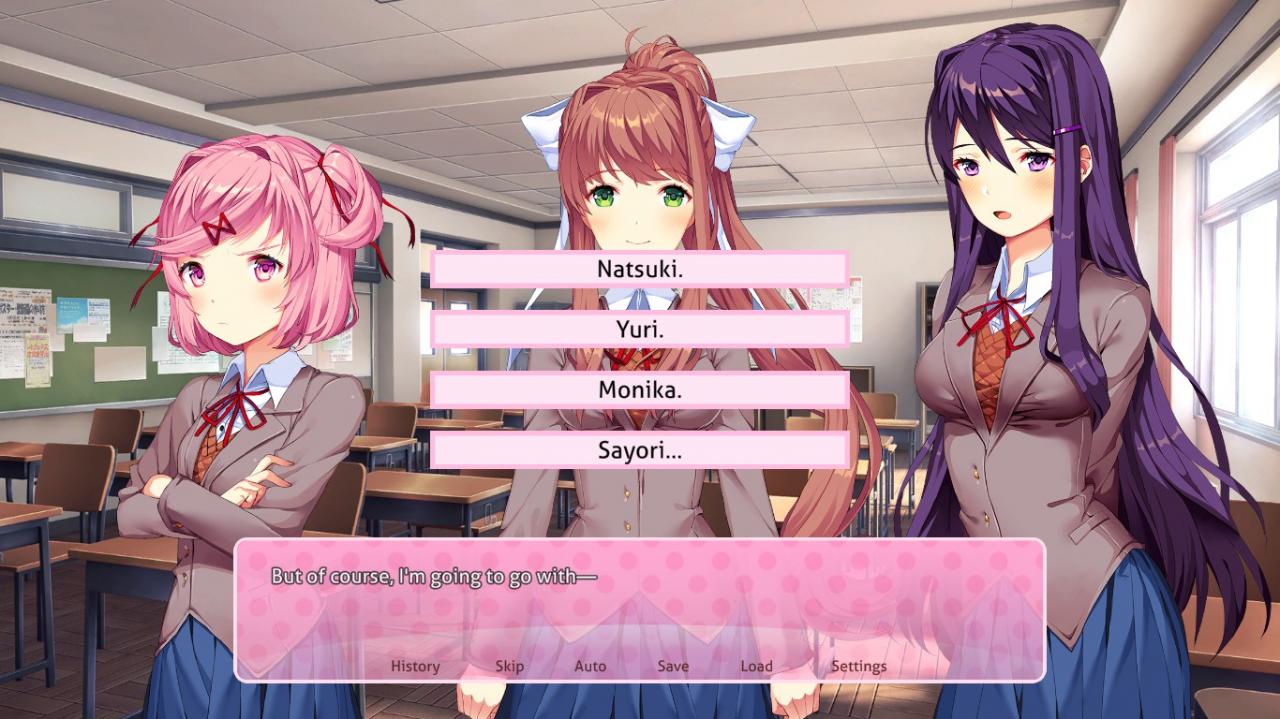
All the members of the literature club are given an assignment to write a poem each night and share them with the group the next day.  Writing said poem consists of selecting 20 words from a series of lists and attempting to select the word that most closely associates with the personality of one of the four girls you're most interested in dating. Sayori is the girl next door (literally), Yuri is the dark and mysterious girl, Natsuki is the small, snarky, and cute girl, and Monika is the out-of-your-league homecoming queen type.  After "composing" your poem, you'll present it to everyone in the club as they, in turn, reveal their poems to you. As you focus your compositions more and more towards the girl of your choice, their attitudes change towards you and the content of their poems shifts from observations about the world to more romantic leanings towards the protagonist. These poems are all really done well and are very thought provoking.  I personally enjoy poetry, and have read my fair share, and I thought that the different writing styles of all the girls were quite unique and their content had some real merit.  It's certainly much better than the average poems I've read over the last few years.

As you work to progress your relationship with the girls, tensions rise between them as they vie for your attention.  There are arguments and hateful comments, that begin to cause rifts within the group. Just as things begin to heat up (not only in terms of animosity between the girls, but also in terms of affection between you and the girl you've chosen), talks begin about preparing for the school's club festival.  This is where all of the clubs around the school set up an exhibit to show what they are all about and try to recruit new members.  This all builds up to your first "date" with the girl you've selected.  It's at this point, that the game takes a drastic shift.  Now, I'm not going to give anything away, but be aware that what happens from this point on is absolutely shocking and unforgettable.  Everything you thought you knew is thrown completely out of the window as a meta-fever dream of shock and confusion sets in.  It's unlike anything I've ever experienced in any other game and feels like a roller coaster that has you questioning your own sanity at times. 

I won't say anymore than that.  If you want to know more, you'll have to experience the game for itself. When I initially played it on PC, back when it came out, it became one of the most memorable gaming experiences that I've ever had.  It really stuck with me... and continues to do so even to this day.  

Presentation:

The game has a very cute presentation with lots of pink, hearts, cute girls, bouncy music, and everything you can think of to make a dating sim appealing.  Of course, it's made this way to trick you into thinking everything is ok before the whole experience goes haywire.  Still, it's very appealing and has a nice charm to it. If I had to describe the style, I would call it, "Female Japanese Middle Schooler."

The character designs are outstanding as is their artwork.  Of course, this is essential to make you want to date the various girls.  If they weren't charismatic and drawn in an attractive way, you'd lose interest before the game tone shifts. All of the characters are very likable and it feels like you really develop a connection with each and every one of them.  This is certainly reinforced by the writing and dialog in the game that is remarkably well done and very believable.  In a game that relies only on narrative, Doki Doki stands head an shoulders above most other video games out there and tells a story that could only be achieved through this form of media.

To round out the fantastic presentation is a catchy and lighthearted soundtrack that fits the game wonderfully.  It's overly cute to match the attitude of the game at the beginning and is... different when it needs to be.


Plus!:

The console releases of the game have some additional content like promotional art that you can unlock, a sound test of the game's soundtrack, and more.  In addition to this, are 7 chapters that focus on the creation of the literature club and how all of the girls became friends and came to overcome their initial struggles with learning to accept each other.  It's a nice gesture, but I feel like these additional chapters don't really serve to make the experience better. Since they are not interactive, you're essentially just watching 4 girls bicker and try to act as pseudo therapists towards each other as they try to explain how everyone should try to be more accepting of personal differences.  It's a noble topic for sure, but it comes across as very preachy and honestly doesn't fit with the tone and concept of the core game.  It truly seems as if it's written by a different person and has a strong "fan-fiction" feel to it that is pretty off putting.  

Also, there are some essential "meta" elements to the PC version that really take advantage of combing through the game's files.  This isn't possible in the console versions, so they present the whole game in a sort of virtual machine setting with a fake desktop, fake email inbox, and file browser.  There's not really any way to get around this part of the game and I think the developers did a fine enough job translating the Doki Doki experience to consoles.  Sadly, it does ruin a little bit of the magic of playing the game the first time compared to playing it on PC.

Conclusion:

Doki Doki Literature Club is one of the most memorable games I've ever played. The world, characters, and experience that Team Salvato created are fantastic and I will never forget my first time playing this game.  While the PC version is the best version of the game to play, you shouldn't pass it up if you only have access to the console versions.  You can play through the whole game in a single session or two, so it's jam packed all the way through and there feels like very little wasted time when you play (excluding the 7 bonus chapters).  If you can handle being shocked and weirded out, and don't have an aversion to reading, you should play this game right away.  Don't just watch a streamer play it or watch a reaction video.  You need to try it out for yourself.

Pros:

  • Very memorable story and general experience overall
  • Likeable characters that are well designed
  • Unlike any other game I've ever played
  • Free on PC!
  • Base game is a perfect length and doesn't waste your time
Cons:
  • The Plus! content doesn't fit well with the rest of the game and feels disjointed
  • Playing through the game multiple times loses a lot of the impact of your first experience with it
  • The "virtual machine workaround" on the console versions loses a lot of the magic of actually playing on a PC
Final Status: Completed

Final Score: 9/10 (10/10 on PC)

Monday, March 21, 2022

Phantasmagoria (PC) Review

Phantasmagoria (PC) Review

Date Released: 24 August 1995

Date Played: 7 July 2019


Introduction:

Phantasmagoria is one of those games that I've played through several times over the last 25 years.  When I was a kid and this game originally came out I didn't have PC that could run it, so I was totally out of luck when it came to playing it myself.  Luckily, I had a friend who's parents seemed to buy him everything he ever wanted (didn't we all have one of those?) and along with pretty much every video game ever made, he also happened to have this one. I spent a good part of the summer of '96 sitting next to him in front of his computer while trying to avoid the scorching heat outside as we worked our way through the game. The internet was in its infancy, but like everything else, my friend had access to it. Sadly, neither of us had the brilliant idea of trying to look online and find out what we were supposed to do when we got stuck in the game.  It's something we all take for granted now, but at the time it was a completely foreign concept. This led us to the classic adventure game loop of getting lost and not knowing what to do.  So, we spent hour after hour trying to brute force our way through the game without any outside help. After getting hopelessly stuck one night towards the end of the game, I went home to sleep.  The next day, when I came back, my friend had finished the game without me!  Needless to say, I was pretty angry with him for making me miss out on the conclusion to the game.  I choked down my frustration and we moved on to something else.  

A few months later, I had finally saved up enough money to buy a decent PC (which was incredibly expensive at the time) and was looking forward to finally get to play some awesome games at my own house for once.  I traded some Magic the Gathering cards to my friend for a big stack of big box PC games that he wasn't playing anymore and was thrilled to start off my collection with some killer titles that he seemed not have any sort of emotional attachment to whatsoever.  In the pile was Phantasmagoria, and it was the very first game that I installed on my new PC; and when I saw the opening cinematic play out in all of its campy glory, I knew I was in for a treat. The next day, I beat the game.  Even now, when I go back to play it again, it feels the same as it did all of those years ago and is still a fantastic and thoroughly entertaining adventure game that is one of the best in the genre.  

Phantasmagoria was written and designed by the legendary Roberta Williams.  She and her husband founded Sierra online and were basically responsible for inventing the graphic adventure game.  Before that, everything was text based and required typed input commands.  When they added graphics to that formula, the point and click adventure game was born and was the genre of game that reigned supreme on the PC for several years. For eight years Mrs. Williams waited for technology to advance far enough to enable her to make the horror game that she had envisioned in her mind and after writing a 550 page script, hiring a team of more than 200 people, and pumping $4.5 million dollars into the project ($3.7 million over the original $800k budged) Phantasmagoria was born. This game feels like it's the culmination of everything Roberta Williams wanted in a game and is, by many, considered to be her best work. 

The game was met with mixed reviews at the time but was a commercial success despite a cut-scene involving a rape that spurred a fairly large amount of controversy.  Although Sierra repeatedly stated that the game was only intended for adult audiences, several large retailers refused to carry the game. While this scene is pretty tame by today's standards, it was shocking that it was part of a video game at the time. The video game industry was still viewed as something exclusively for children by most of the public and there was a strong backlash from more conservative parties in reference to topics and features they deemed immoral being featured in media for the youth. This caused Phantasmagoria to gain a somewhat dark and seedy allure that continues to this day.


Graphics and Presentation:

Normally, I wouldn't begin my review of a game with the graphics, but in the case of Phantasmagoria, they seem to be the component of the game that most people remember. They were a huge selling feature when the game came out and were the biggest draw for the public. When you first open up the physical box the contains the actual game, you're greeted by an entire folio of CD-ROMs. There are 7 in total, more than I can recall seeing in any game I've ever encountered in my entire life.  The reason for this is because the game was filmed like a movie in a $1.5 million dollar bespoke studio with a cast of twenty-five actors who all performed in front of a blue screen.  This was all digitized and and added to the game both in terms of cut scenes as well as actual gameplay in classic FMV (full motion video) style. The real actors are visualized on the screen and are inserted into pre-rendered 3D backgrounds.  As you click to move your character, from location to location, actual video of the actors plays as you see them walk, interact, and talk about the intended target. You'll explore the disturbing mansion, surrounding outdoor areas, and the the local town as you point and click your way through the beautiful environments.  It's a striking visual style that was mind-blowing at the time of it's release and still holds up extremely well today while many other FMV games absolutely do not.  With over 1000 different screens, several different locations, dozens of items to interact with, and hours of dialog it's no wonder that the number of CD-ROMs is so bloated to accommodate the sheer amount of content in the game. 


In addition to this, the game contains a spooky Gothic soundtrack that contains Gregorian-style chants that were performed by a 135-voice choir.  The music is not only intense and haunting, it's quite memorable and really helps fill out the over-the-top presentation of the entire game. This is quite apparent from the opening cinematic of the game that really turns everything up to 11. During the more tense moments of the game, you can always count on the choir's ooohs and ahhhs to add to the atmosphere in a very chilling way.

For a point-and-click adventure game, Phantasmagoria has it all in the presentation department. It is still the most atmospheric, best looking, and coolest setting I've ever seen in a game from the genre and hangs up there with Myst for a memorable experience. Yes, it's an FMV game that was all the rage at the time and I know that that can be a bit of a black mark on a game.  But, this is one of the best examples of doing-it-right that is out there and you shouldn't let all of those other terrible games turn you away from this one.

Story:

You play as mystery novelist Adrienne Delaney (Victoria Morsell) and her photographer husband Don Gordon (David Homb) who have purchased a mansion in a sleepy little down in New England.  The mansion itself has been on the market for some time and the couple were able to procure it for next to nothing due to its history of a 19th century magician named Carno (Robert Miano) committing a series of murders there. It's a classic horror story device that we've all seen again and again, and you can tell Roberta Williams is trying to pay homage to the concept. Once the couple arrive, Adrienne begins having nightmares involving the unfortunate past in the mansion.  Her loving husband, Don, supports and consoles her and she begins to feel better. As she explores the mansion and surrounding areas, she begins to uncover mysteries, clues, and strange messages about the the horrific events that took place. After discovering a secret altar hidden in the mansion, Adrienne accidentally unleashes an imprisoned spirit that possesses her husband.  As she continues to explore the estate over the next several days, her husband begins to behave more and more strangely and aggressively towards her, finally causing her to fear for her safety. As you continue to delve further into the mansion's history, you begin to learn that Carno practiced black magic and as the mystery unravels, you'll get to relive the gruesome and elaborate ways the Carno committed his murders and see them first hand in some of the most outrageous set pieces committed to any FMV game.  If you have your wits about you, you'll get to uncover the horrific past and the mansion's secrets to save not only your husband, but also yourself.

Despite the game being more well known for it's graphic presentation and controversy, the story, setting, and acting are the real stars of the game.  All of the locations in the game are expertly crafted and feel real despite them being nothing more than pre-rendered graphics with performers in front of a blue-screen.  The art design has a whimsical but creepy nature that evokes not only memories of Tim Burton, but also Dr. Seuss and is a welcome addition to the atmosphere. The performances by the actors are all very good despite them not being "big names' in the industry and they carry the game. David Homb's performance as Don is the real standout and watching his descent into madness is fantastic.  His acting is so over the top that it borders on cringeworthy, but it's perfect in this scenario. I wouldn't have it any other way.  On the other hand, Victoria Morsell performs Adrienne in a very demure and subtle manner.  She's made out to be the typical weak female lead (at first) and you really begin to sympathize with her and her situation of being under all the weight of not only her progressively more insane husband, but also that of the mansion itself. It really makes you feel like your in an old horror movie, and it's very enjoyable if that's your cup of tea.


Gameplay:

Despite the game being a huge departure and step up in terms of story and presentation, the gameplay is still point-and-click adventure through and through with almost no innovation. You wander around from screen to screen looking for objects to collect and items to interact with in order to solve puzzles or gain access to blocked off areas. Luckily, the puzzles aren't as esoteric as your average adventure game of the time (excluding chapter 7).  You'll still spend a lot of time picking up items and trying them on every other object you come across hoping that you'll somehow figure out how to advance.  Unfortunately, there are still a few puzzles where if you do them incorrectly, you can soft lock yourself and won't be able to finish the game without restarting or loading a previous save (I'm looking at you sliding the newspaper under the pantry door puzzle).  Fortunately, there is a "hint master" represented by a red skull on the bottom left of the screen.  You can click him for clues whenever you need help.  At first he is rather vague and will only give you a slight hint on how to solve a puzzle, but if you're still not able to figure out what to do, his clues get more and more blatant.  Sometimes this is to the point where he flat out tells you the solution. Other times, his clues are still so vague that you'll continue to be stuck even after exhausting all of his dialog options on the subject. This hint master is a really nice addition to the game and I wish more adventure games employed something like him.  However, the temptation to use him too often is pretty bad and I wish he had more of a limit, or a timer, or something else to keep you from just clicking him instantly the second you get stuck.  Even though the game has it's difficulty toned down, less non-sensical puzzles, and a literal helper to aid you, there are still several times you will get lost and won't know what to do. Don't feel bad if you have to resort to looking up a walkthrough online, there are a lot of small objects you need to interact with that are quite easy to miss.  

Conclusion:

Although I'm not a huge fan of the point-and-click adventure game genre and it's esoteric gameplay loop drives me crazy, Phantasmagoria is still a fantastic game and is by far my favorite in the genre. While I feel the gameplay is dated and the FMV was a relic of the past, the game is very immersive and interesting and is still entertaining today.  The campiness surrounding the game and the performances of the actors as they develop and go through their story arc really helps drive the game forward through its 7 chapters and the controversial scene that almost prevented the success of the game is pivotal for setting the tone of the game and it wouldn't be the same without out it. It's an important part of gaming history and plenty of people out there have nostalgia and an odd fondness for this game that I feel is warranted.

If you like FMV games, campy horror movies, point-and-click adventures, or are just a video game aficionado, you should definitely give this one a try.

Final Status: Completed 

Final Score: 8/10 (Everything is great except for the slightly dated gameplay)


Monday, October 11, 2021

Kholat (PS4) Review


 Kholat (PS4) Review

Release Date: March 8, 2016

Date Played: October 11, 2021


Up next on Horror Month 2021 is Kholat. Developed by Polish Developer IMGN.PRO. I added this one to my wish list after I saw Radical Reggie recommend it on a pickups video he did.  It sat on my wishlist for a good long while until it finally went on sale in the UK for $16.49 with free shipping.  I imported it and it sat on the shelf for a couple of years before being randomly selected to play.

You play as an investigator who is following the steps of the 10 Russian hikers that went missing during the Dyatlov Pass Incident in 1959.  It's a true story where their camp was destroyed and they cut their way out of their tent only to be discovered dead in their underwear many yards away.  They had cuts on their bodies and appeared to have the daylights scared out of them.  Many mysteries surround the case and a lot of them are still unanswered to this day.  There are plenty of supernatural and Earthly explanations theorized over the last decades and the story continues to fascinate a lot of people. Just reading the Wikipedia article of this strange event is fascinating and seems like the perfect setting for a horror game. I would consider myself to have a mild interest about the situation and was excited to try the game.  

From the title screen you're welcomed by magnificent music in the form of sparse piano accompanied by swelling strings and wistful female singling. It really evokes a sense of melancholy and uneasiness. It's truly spectacular and couldn't fit the game any better. The rest of the music in the game is also great and is used very well.  It is often playing and is the real star of the show.  On top of this is narration by none other than Sean Bean.  He of course performs wonderfully as do the other voice actors that were used to narrate the game.  

As for the game itself, it's a horror based exploration game.  It's kind of in that walking simulator genre, but is actually based more on an orienteering mechanic.  You're given a map, compass, and several sets of coordinates and are supposed to go investigate the 10 locations the hikers visited before that great tragedy befell them.  You can't see your location on the map and have to orient yourself from the clues you find and your surroundings.  Now, I'm just going to come right out and say it, I absolutely hate navigating around in this game.  I know how to use a map and a compass, but you normally don't have to use those in mountain passes that act more like mazes than open areas.  The vast majority of the time you'll be lost with no way to discover where you are until you randomly stumble onto one of the 10 locations or find a clue that will put a new marker on your map. The new pinpoints on your map are there to serve as markers to help you locate where you actually are, but often times they didn't seem to appear on the map in a location that resembled my surroundings.  For example, there was one clue on the right side of a long road.  When it appeared on the map, the icon was to the left of the road and set back a distance. This made me feel like I was going the wrong direction, so I turned around to retrace my steps.  It was only after 5 or so minuets of going back the way I came before I realized that I needed to turn back around and heat the other way.  These clues not only "help" with locating yourself on the map, but they also help fill in the story and are quite often voice narrated. Like I said, these performances are often really good.  The clues range from spiritual philosophy, supernatural explanations, and journal entries that help flesh out the whole situation. It does help build an atmosphere that is somewhat intriguing.  Adding to that intrigue is the gigantic world of Kholat.  It's snowy, mountainous, and forested. It can be quite beautiful, but it's so full of valleys and jagged peaks that it impedes your view of your surroundings and gives the game a very claustrophobic feel that isn't very welcome.  This works against the game in terms of immersion and the stupid orienteering mechanic.  There are also really short draw distances in the game.  So, even if you go up to a vantage point to try to plan your next move, you can't see anything in the distance.  

There are orange supernatural spirits in various locations on the map, and if you run into one of them you're done for.  You die and go back to the last new clue or location you discovered.  Sometimes this will set you back 30 seconds, other times it can set you back 30 minutes.  Often times, you'll just come around a corner and run smack into one of the orange spirits and have no time to react.  Or, an orange fog will come spilling down the side of the mountain and you have to outrun it.  It's all frustrating and feels cheap. When you die, you're greeted with a load screen that lasts about a minute before you can jump back in.  This makes these accidental deaths all the more irritating and rage inducing. I know these orange spirits (and the other supernatural events in the game) are supposed to add to the scariness, but it never really gets there.  They just feel like more of a hinderance to your progression rather than being the main mechanic of the game itself. I feel like the game should be about you escaping from the monsters that killed those hikers rather than it being about waiting for the monsters to get out of your way so you can go read more journal entries.

Speaking of running, it's mapped to the the R3 button in this game; which is idiotic.  Not only that, you have to continually hold it down to keep running.  This is such a terrible gameplay flaw that I can't overstate it.  After about 20 seconds of this, you'll have a hand cramp.  Hell, an hour after I stopped playing (as I'm currently writing this review) my hand is STILL sore from it.  This HUGE oversite is made even more grievous by the fact that there are unused L1 and R1 buttons on the controller.  Why couldn't the developers map it to one of the unused buttons, or at least give us a chance to rebind what the buttons do in the game? I know this doesn't seem like such a big deal, but trust me, when you play this game it's all you can think about.   You want to run so badly because you walk so slowly and everything is so damn boring that you just need to get a move on.  This button mapping gets directly in the way of you eking out what little enjoyment there is to be had in this game.

On the technical side, the sound design and score are outstanding (as mentioned earlier).  The graphics aren't great and have an early Xbox 360 feel to them.  I also encountered a fair amount of framerate drops that really took me out of the game.  These would often occur when you were near one of the 10 locations you're trying to discover.  These are usually accompanied by some sort of set piece to ratchet up the tension.  Unfortunately, when this happens and the framerate drops it basically gives you a heads up that something big is happening and spoils the surprise.  You can tell that the developers are pretty new to the game.  It's not uncommon for your first game to be a little rough around the edges, and this one certainly fits that description.  But, I can't fathom why they thought the orienteering mechanic would be something people would enjoy doing.  Walking simulators have a bad enough reputation as it is.  I'm guessing they didn't know how to tell the story they wanted to and relied on the walking simulator format as a vehicle to make it into a game.  Then, they added the navigation aspect to try to add some more "gameplay" to spice up the experience.  Sadly, this backfired, in my opinion and it ended up being a hindrance rather than a strength.

My final thoughts on the game are obviously very negative.  Other than the music and sound design I didn't enjoy this game at all.  The orienteering game mechanic isn't fun and makes playing the game a chore.  Piled on top of that is the fact that it's literally painful in your hand to run in this game.  It just makes the time you spent wondering aimlessly around the map all that more frustrating.  The setting is really cool, but they don't do enough with the awesome material they've selected and instead just focus on random bits of lore to add to the generally creepy vibe rather than construct a real story.  As I've mentioned before, I have a gaming sin called, "Esoteric Bullshit" where you have to wander around trying to figure out what you're supposed to do.  It's probably my biggest pet peeve in gaming and Kholat is a game built around that pet peeve.  You're always lost and can't even find your location most of the time and it just makes your time in their world feel like there's no urgency or direction.  I hated it.  I know the game got mixed reviews (mostly leaning negative), but I never though it would be this bad.  

I couldn't bring myself to finish the game and after 3 or so hours...  and with an aching hand I threw in the towel and decided to move onto something more worth my time. 

Final Status: Played for several hours... and quit.

Final Score: 3/10 (Bad)